Unlock the full potential of your budget
Discover how to allocate your budget for maximum impact with Exactag's AdSpend Optimizer.
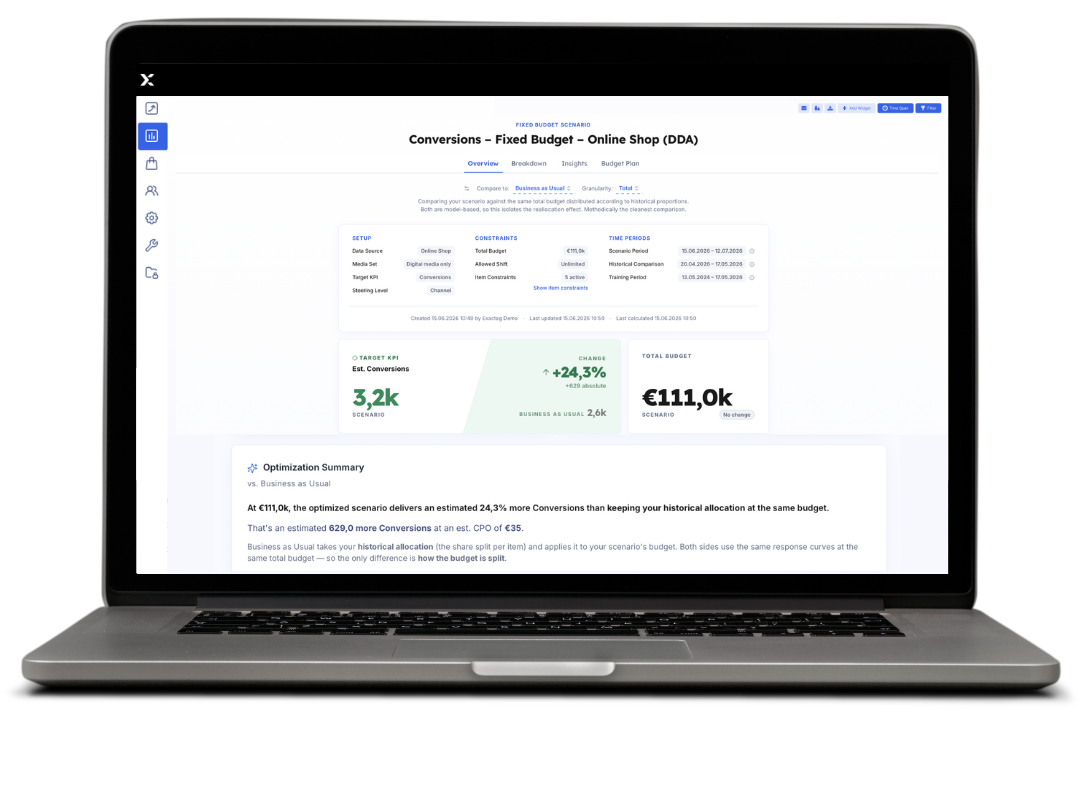
Make confident budget decisions, faster and smarter.
Every media plan faces the same question: you have a total budget, and it has to work as hard as it can. Our AdSpend Optimizer gives you a structured way to get that answer across your full media mix. With just a few clicks, you can run through different scenarios and see how your marketing budget should be distributed across channels to achieve more conversions with the same spend, or reach your goal with less budget.

Optimize budget allocation
How do I allocate my budget optimally?

Identify growth potential
Where is untapped reallocation potential?

Understand headroom
Which channels are saturated, which are scalable?
Most media mixes have room for more efficiency, and the questions around it vary in scope, some are detailed, others sit a level higher and others are broader:
- Inside a campaign, which publisher is producing the desired result and which is not?
- Would adding budget to a given campaign still produce returns, or has it reached its limit?
- How would the estimated outcome change if you shifted budget from SEA into TV?
The AdSpend Optimizer reads each question against your own measurement results and shows an estimated outcome for any allocation you consider, so the direction you take is backed by data rather than assumption.
Everything a budget decision needs, in one scenario
- Your data, not someone else’s: response curves are built directly from Exactag’s own attribution and modeling results, not from third-party data, platform-reported metrics, or generic benchmarks.
- Fast enough to make planning iterative: a scenario calculates in under a minute.
- See the result in context: See the result in context: next to your measured results (Historical), every run also estimates Business as Usual and an unconstrained optimum.
- Optimize at the level you actually steer: channel, campaign, publisher, or any combination, freely selectable per scenario.
- Digital and offline in one scenario: one results page, one consistent measurement basis, across the full media mix you actually steer.
- Read the estimated impact across other metrics: see whether a reallocation that pushes one KPI up is pulling another down, and by how much.
Plan your budget in under 10 minutes
Set up what to optimize, then fine-tune it to the exact question you need answered – just in a few clicks.
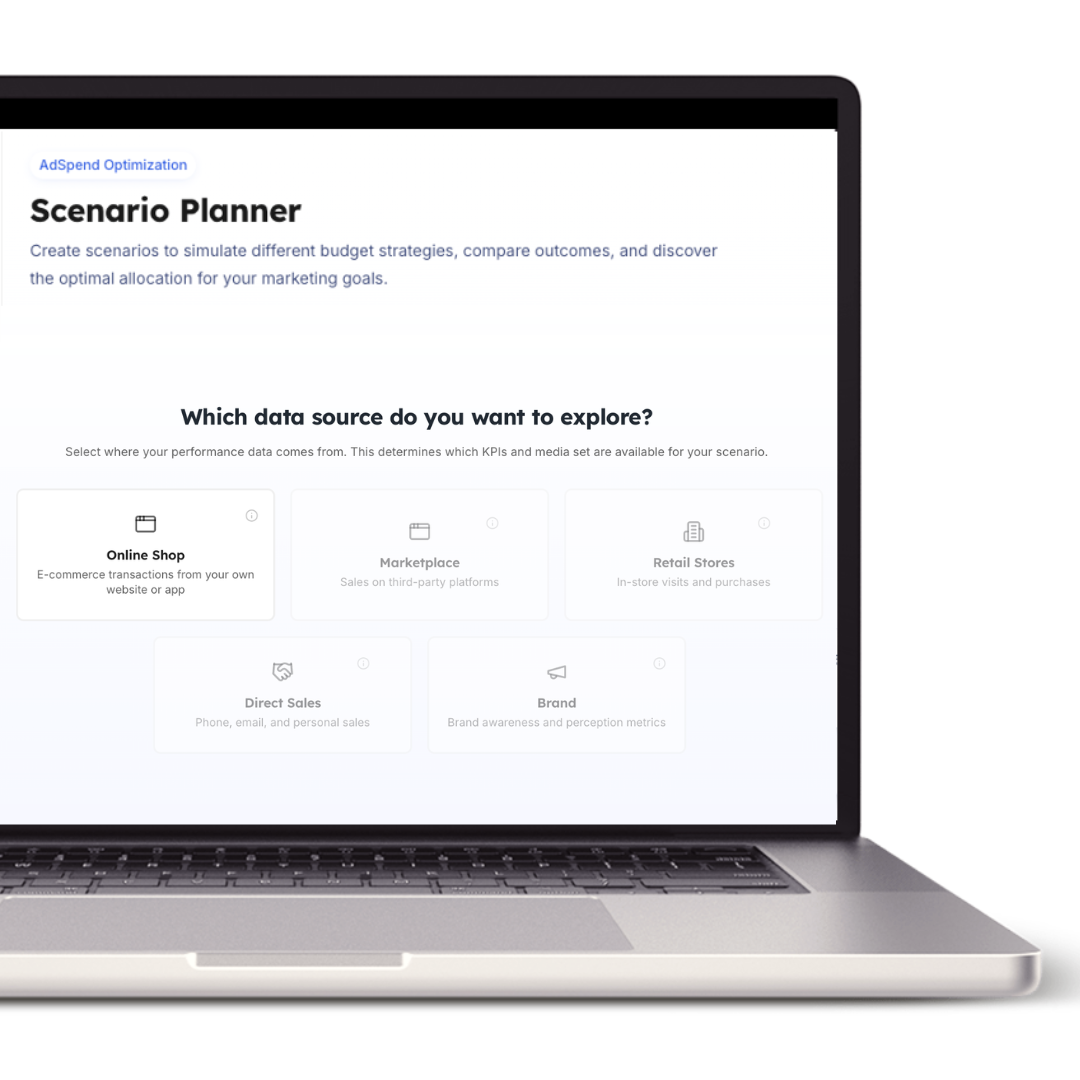
Give the AdSpend Optimizer a total budget and a target KPI, it finds the allocation your measurement results point to, and shows what that allocation is estimated to deliver, next to what your current mix delivers.
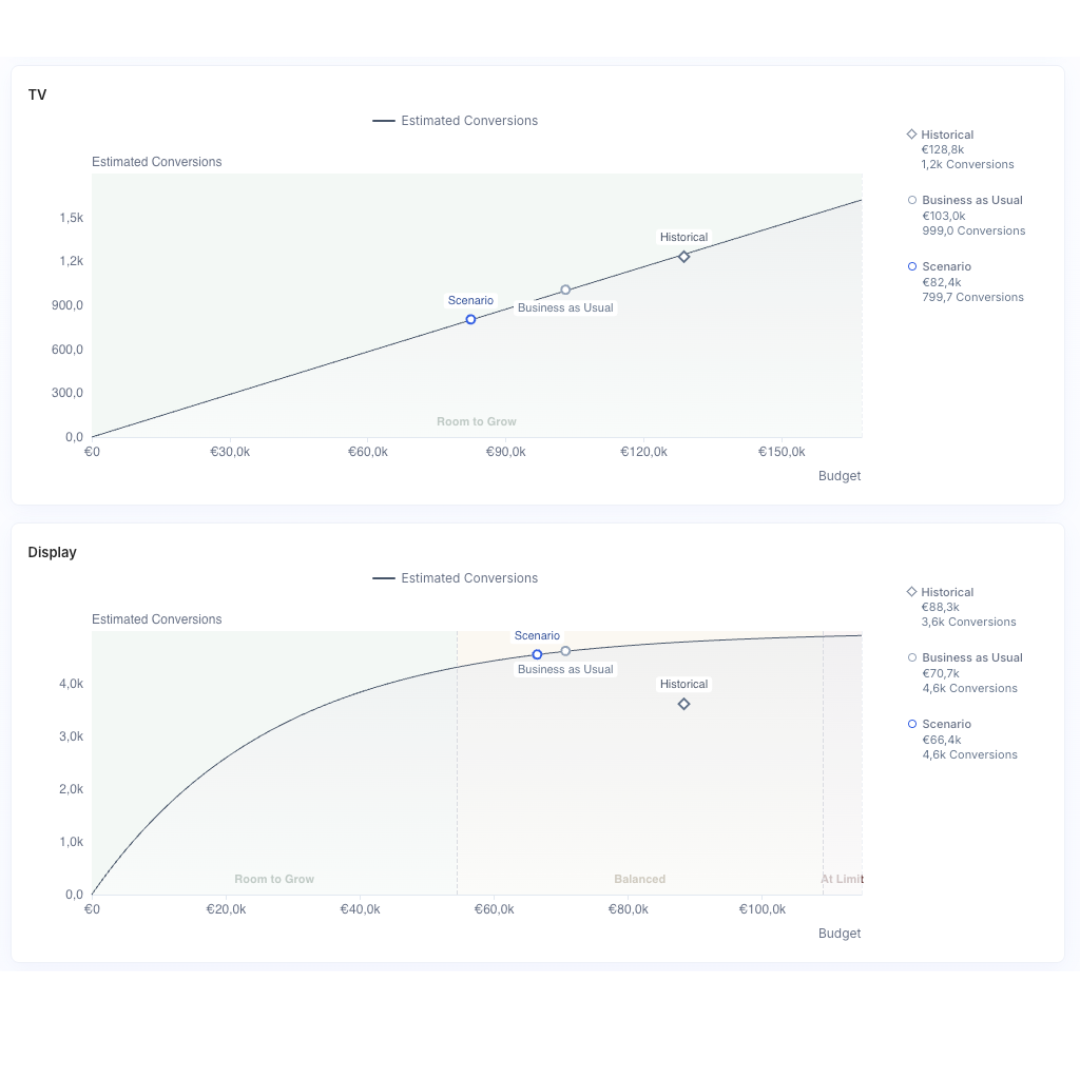
The AdSpend Optimizer builds on your own Exactag measurement results: the same attributed data you see in your reporting feeds a response curve for every channel, campaign, or publisher you plan.
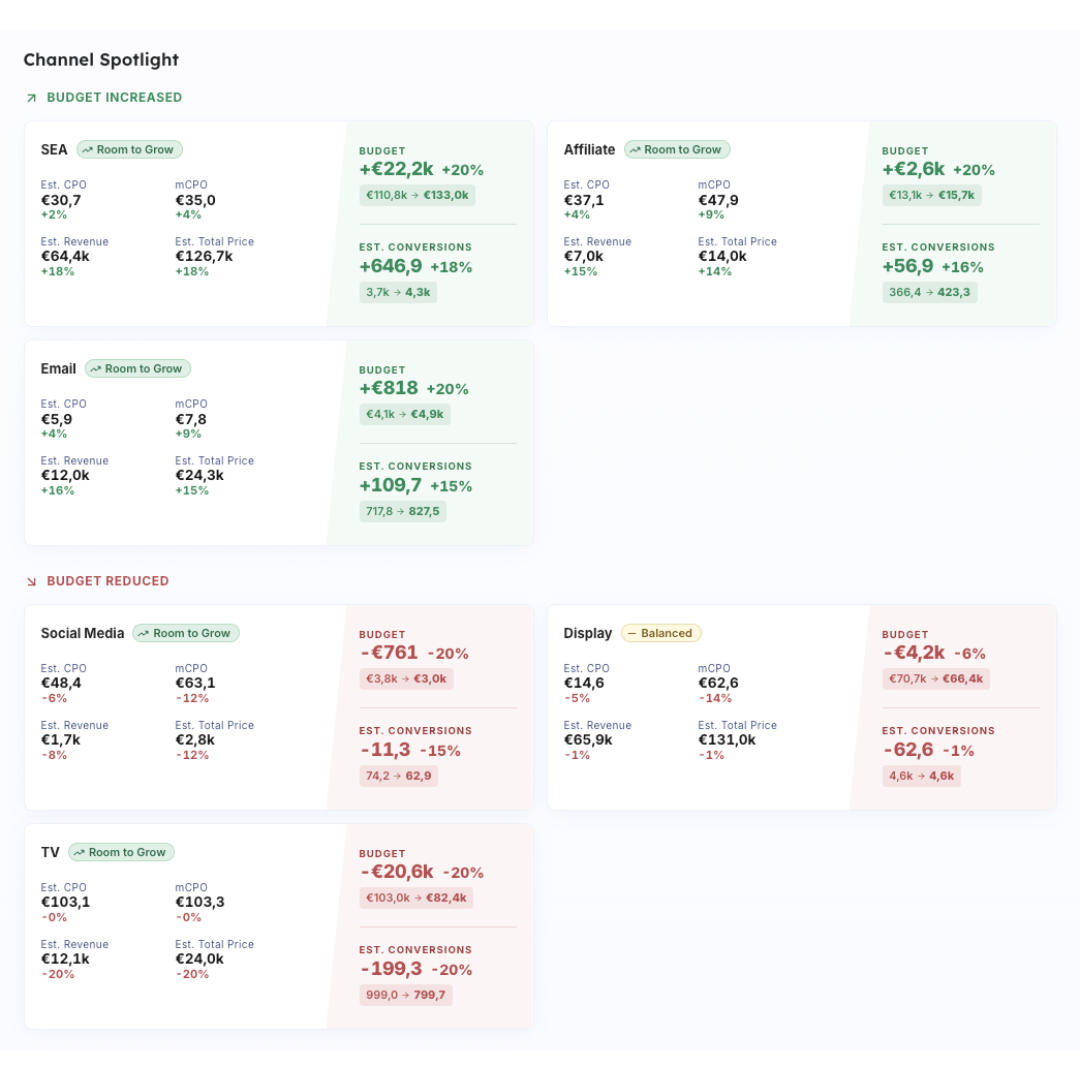
For every paid channel (digital + offline) you see where your historical spend sits, where the optimized scenario lands, and how much headroom remains before additional budget stops paying off.
In a discovery call, we look at your media mix together and walk through what the AdSpend Optimizer would surface for your specific setup.
FAQ
Common questions
What is the AdSpend Optimizer?
The AdSpend Optimizer is a budget planning and optimization tool that shows optimization potential across your campaign structure. It finds the budget allocation that works toward your goal most efficiently. It closes the gap between measurement and budget decisions: it turns attribution and modeling results into choices at the level you actually control.
What makes the AdSpend Optimizer valuable?
It adapts to the actual planning decision and business context. By choosing the level of detail, the channels you include, and the metric you are optimizing for, you can answer anything from a tactical question (which publisher within a campaign still pays off) to a strategic one (how to split budget across channels).
Does the AdSpend Optimizer replace my media planning process?
No. It gives you a shared, data-grounded reference point to bring into the process you already have.
How does the AdSpend Optimizer work?
It builds a response curve for each item, for example a channel, fresh with every run, based on your own attribution and modeling data. An algorithm then directs budget across those curves to the optimum combination.
How is the AdSpend Optimizer different from a forecast, a prediction, or a trend analysis?
It is a scenario simulation, not a forecast. It reads response curves built from your own measurement results and shows, under the assumption of stable market conditions, what allocation gets you the highest estimated outcome.
Can I include offline channels and store conversions?
Offline media (TV, radio, print, OOH,…) can already be part of the optimization. The AdSpend Optimizer includes those channels alongside digital ones, using attribution modeling extended to capture their impact. The outcome it optimizes for is still your online shop: purchases, sign-ups, and other tracked actions on your website and app. Store and other offsite conversions are on the roadmap, not yet available.
What is the recommendation based on?
The AdSpend Optimizer builds one response curve per item from your own measurement results, then finds the allocation with the highest estimated outcome for the metric you are optimizing for. Every scenario is framed against three automatic reference scenarios: Historical, Business as Usual, and Unconstrained. That way you see what the result is worth against three different baselines, not just a single number.
What data does the AdSpend Optimizer need, and how far back does it look?
It uses up to 24 months of your own measurement data, weighted so recent performance counts more. Every item’s data sufficiency is visible before you act on it. An item without enough reliable history is shown but excluded from optimization, so its historical budget and outcomes pass through unchanged instead of being silently modeled on thin data.
Which KPIs can I optimize for?
Any metric you have set up in your account, commonly conversions, revenue, or total order value, which lets you effectively optimize toward ROAS or cost-per-order. Every other metric you track is shown alongside as its estimated impact, so trade-offs are visible before the plan goes out.
How granular can I steer the optimization?
As granular as the decision you need to make: channel, individual campaign, publisher, or any combination of those, freely mixed within one scenario, even per channel. A CMO can work at channel level for direction-setting; a media planner can go down to individual campaign and publisher level for day-to-day decisions.

